


Federal Cannabis Rescheduling Update: Timeline, Implications, and What Happens Next
The moment the cannabis industry has been anticipating for years has finally arrived, at least in part. On April 23, 2026, the U.S. Department of Justice and the Drug Enforcement Administration announced the most consequential shift in federal cannabis policy in more than five decades. But while headlines have celebrated the milestone, the full picture is more nuanced. Which, for cannabis professionals, means understanding exactly what changed (and what hasn’t) is essential.
Here’s a comprehensive breakdown of the rescheduling timeline, what the April 2026 order actually does, and what comes next.
The Road to Rescheduling: A Brief Timeline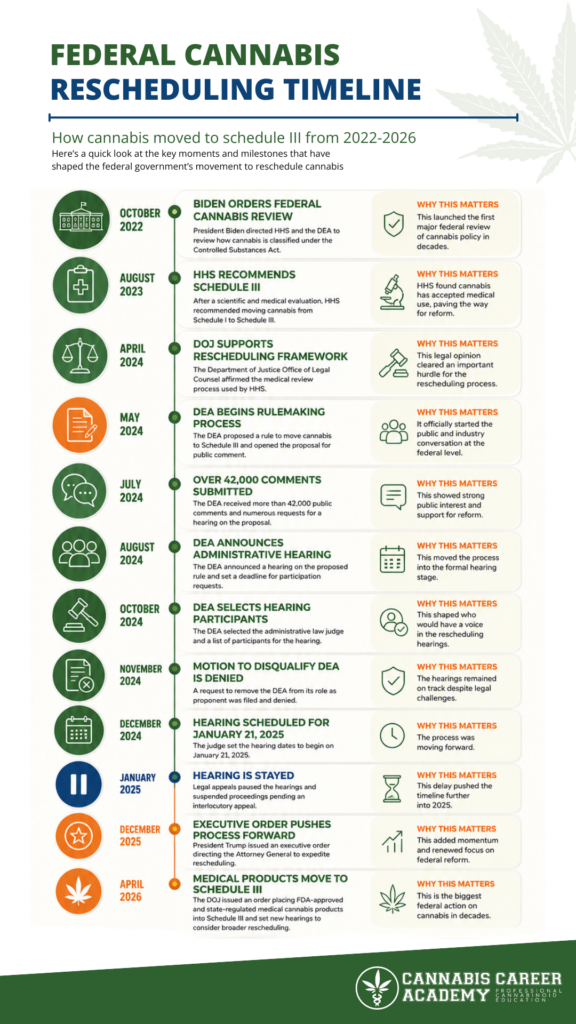
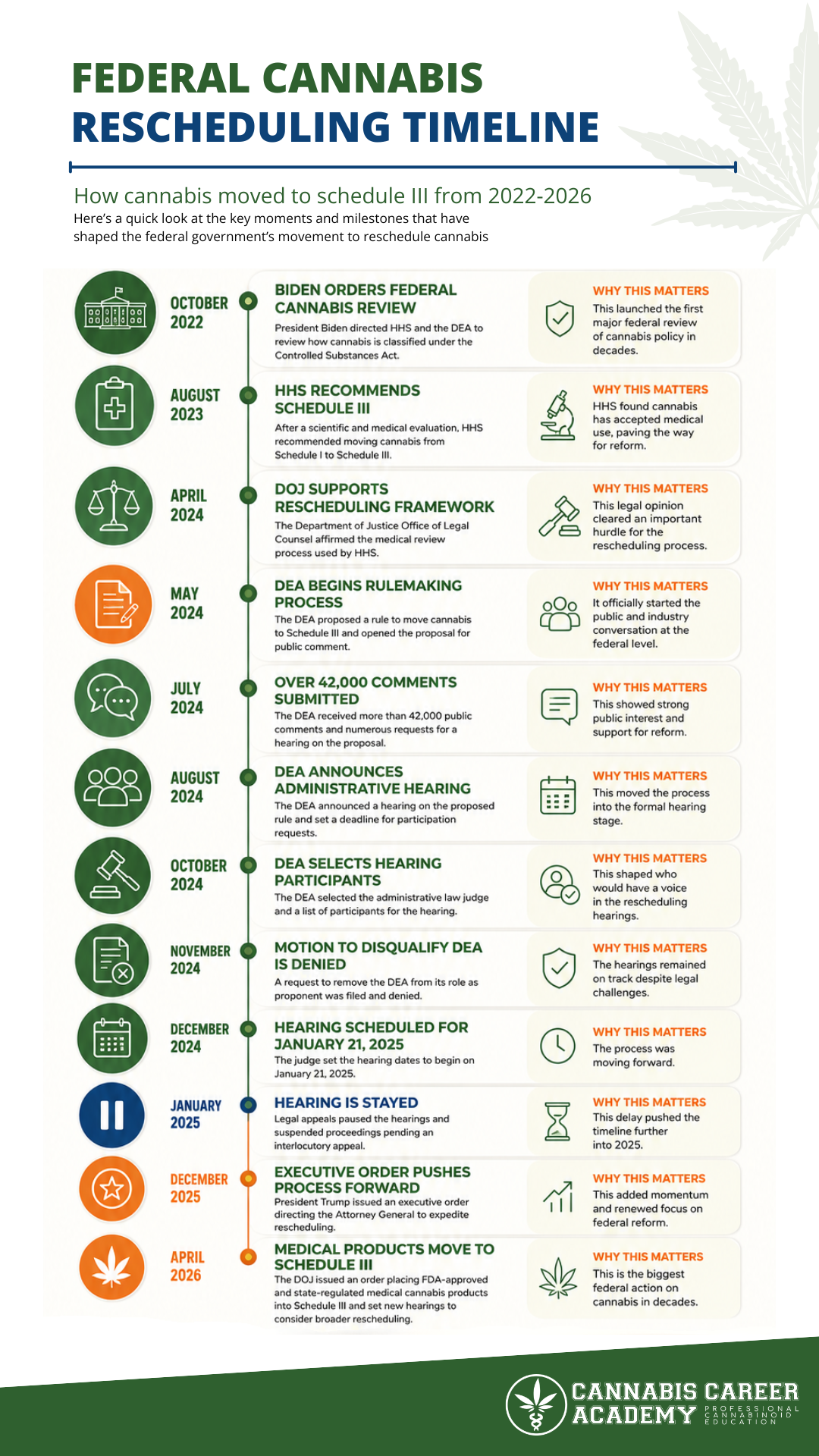
The path to rescheduling has been years in the making. Here are the key milestones:
October 2022 — President Biden directs federal agencies to reassess marijuana’s Schedule I classification, kicking off a formal review process.
August 2023 — The U.S. Department of Health and Human Services completes its scientific evaluation and formally recommends the DEA reschedule cannabis from Schedule I to Schedule III, finding it has accepted medical use.
May 2024 — The DOJ publishes a Notice of Proposed Rule making to reschedule marijuana to Schedule III, generating nearly 43,000 public comments.
August 2025 — The DEA’s administrative law judge overseeing the rescheduling hearing retires, briefly stalling proceedings.
December 18, 2025 — President Trump signs Executive Order 14370, “Increasing Medical Marijuana and Cannabidiol Research,” directing the Attorney General to finalize the Schedule III reclassification “as expeditiously as permitted by law.”
April 22–23, 2026 — Acting Attorney General Todd Blanche signs a final order moving FDA-approved cannabis products and state-licensed medical cannabis to Schedule III, effective April 28, 2026. The order is the most significant change in federal marijuana law in over 50 years.
What the April 2026 Order Actually Does
It’s important to read this order carefully. It is *historic* but it is not blanket legalization.
What IS covered:
1. FDA-Approved Cannabis Products Drug products containing marijuana that have been approved by the FDA are now Schedule III substances.
2. State-Licensed Medical Cannabis Cannabis products sold under a qualifying state-issued medical marijuana license are immediately rescheduled to Schedule III, effective April 28, 2026. This is the big win for the industry’s medical sector.
3. Section 280E Tax Relief for Medical Operators. Because IRS Section 280E only prohibits standard business deductions for businesses trafficking in Schedule I or Schedule II substances, the rescheduling immediately lifts that tax burden for state-licensed medical cannabis operators. Under Schedule I, many cannabis businesses faced effective tax rates as high as 70–90%, compared to the standard 21% corporate rate. Industry estimates suggest this could unlock roughly $2.3 billion in annual tax savings across the medical cannabis sector. A typical dispensary could save approximately $268,000 per year, with high-volume locations saving up to $800,000.
4. DEA Registration Pathway for Medical Operators The order establishes a fast-track process for state-licensed medical cannabis entities to register with the DEA and comply with the federal regulatory framework governing Schedule III substances — including record keeping, security, disposal, and labeling requirements. The DEA’s Medical Marijuana Dispensary Registration Portal opened on April 29, 2026, with a $794 annual application fee.
What is NOT covered:
Adult-Use / Recreational Cannabis Cannabis outside the FDA-approved or state-licensed medical systems — including sales at adult-use dispensaries in recreational states — remains Schedule I pending the outcome of the June 29 hearing. This means the 280E burden continues for recreational operators for now.
Hemp-Derived THC Products The order does not address hemp-derived THC products, which remain in a separate and still-evolving regulatory landscape.
What’s Next: The June 29, 2026 Hearing
The April order is only the first phase. Simultaneously, the DEA announced an expedited administrative hearing beginning June 29, 2026, to consider whether cannabis in its entirety, including adult-use cannabis, should be moved from Schedule I to Schedule III.
The hearing is scheduled to conclude no later than July 15, 2026. Following the hearing, if the broader rescheduling is completed, a final rule could be published in the Federal Register as early as late July 2026.
If the broader rescheduling is finalized, that would extend all Schedule III benefits, including 280E relief, to adult-use operators as well.
Expect legal challenges. Opposition groups have indicated they will challenge rescheduling through litigation, so even a favorable ruling out of the June hearing may face delays in federal courts. Cannabis operators should monitor developments closely.
Key Implications for Dispensary Professionals
Whether you work in a medical dispensary or an adult-use store, these changes have direct, real-world implications for your day-to-day role:
Compliance requirements are expanding. Medical dispensaries are now entering the DEA registration process for the first time. That means new federal record-keeping obligations, security protocols, and labeling standards layered on top of existing state requirements. Staff at all levels need to understand these requirements.
Tax structures are changing. For medical operators, the removal of 280E opens up entirely new conversations around pricing, budgets, and reinvestment. The combined effective tax rate for qualifying medical operators is projected to drop from above 50% to somewhere in the 25–35% range, depending on the state. Dispensary teams need to understand how that affects their operations.
Hiring is accelerating. Cannabis staffing firm Vangst reports that requisitions previously frozen are reopening, senior-level talent previously hesitant about the industry is now engaging, and entirely new roles like regulatory affairs leaders, clinical operations heads, and federal compliance counsel are becoming top hiring priorities. A more professionalized, federally regulated industry demands a more credentialed workforce.
Product and patient conversations are evolving. With federal recognition of cannabis’s accepted medical use now official, budtenders and patient care specialists need to be equipped to speak with greater authority and nuance about the products they’re recommending, especially as medical and adult-use programs navigate different regulatory tracks.
Unanswered Questions to Watch
Not everything is resolved. Key open questions include:
-
- Retroactive 280E relief: Will the IRS allow medical operators to amend prior-year tax returns to reclaim disallowed deductions? The order encourages Treasury to consider retroactive relief, but formal guidance has not yet been issued.
- Recreational dispensary timelines: The 280E burden remains for adult-use operators until the June 29 hearing produces a broader final rule.
- Banking and capital access: Rescheduling opens doors but does not fully resolve banking barriers, which also depend on SAFE Banking legislation.
- Litigation risk: Any final rule expanding rescheduling to all cannabis could face legal challenge, potentially delaying implementation for months.
Why This Is a Critical Moment to Invest in Your Cannabis Career
A federally regulated cannabis market demands federally informed professionals. Dispensary staff, brand ambassadors, and retail managers who understand compliance, product knowledge, and evolving regulations will be the ones who thrive in this new landscape.
That’s why our Dispensary Agent Certification Course was designed specifically to give you the foundational knowledge and professional credibility to succeed in this rapidly evolving industry. From compliance and patient care to product expertise and cannabis law, our program covers exactly what today’s dispensary employers are looking for!
This post is for informational purposes only and does not constitute legal or tax advice. Cannabis operators should consult qualified legal and tax counsel regarding their specific circumstances.