

Types of Cannabis Vapes: Oil Carts, Vape Pens, and Everything Inside Them
Walk into any dispensary today, and you’ll find an entire wall dedicated to vapes. They come in every color, brand, and price point imaginable. But once you get past the packaging, the real differences come down to two things: the device in your hand and the oil inside it. Understanding the different types of cannabis vapes is what separates a confused shopper from a confident one.
Vapes have become the second best-selling cannabis product behind flower, and it’s not hard to see why. According to BDSA’s consumer research, 43% of inhalable cannabis consumers reported using vapes in the past six months, with ease of use (57%), portability (41%), and discretion (36%) ranking as the top reasons people reach for them. They’re convenient, they’re relatively low-odor, and they’ve gotten a lot more sophisticated in recent years.
Here’s what you actually need to know.
Part One: The Device
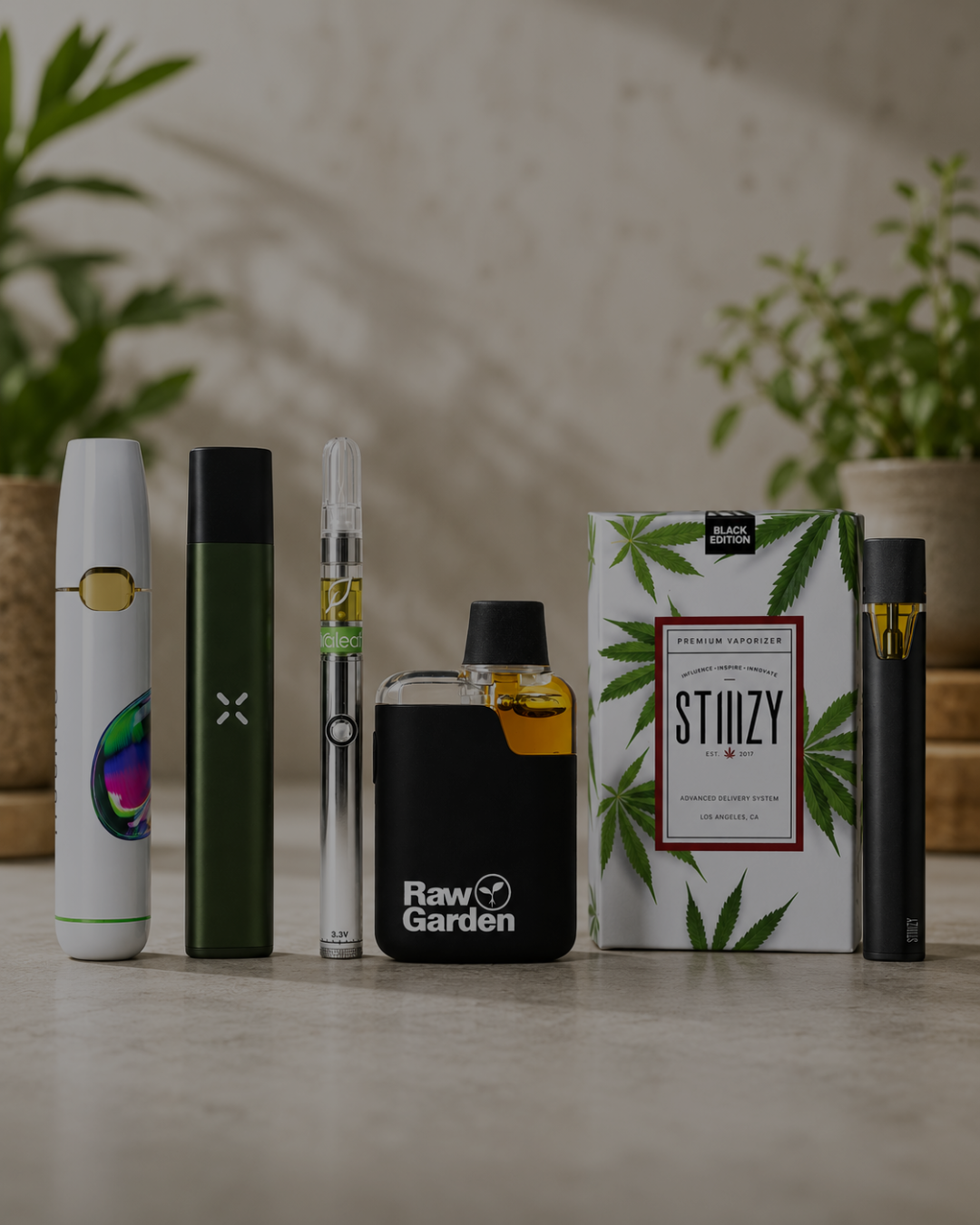
Before getting into what’s inside the cartridge, it helps to understand the hardware itself. There are two main formats you’ll see at a dispensary.
510-Thread Cartridges
The 510-thread cart is the industry standard. The “510” refers to the threading on the connector (10 threads at 0.5mm each) and because it became the dominant standard early on, the vast majority of cartridges and batteries on the market are compatible with each other. You buy the battery once, then swap in whatever carts you want.
A 510 setup typically runs $20-60 for a cart, and the battery itself is a one-time purchase you’ll reuse indefinitely. You get the flexibility to try different brands, strains, and oil types without committing to a new device each time. The tradeoff is that you do have to keep the battery charged and occasionally deal with clogging, especially with thicker oils like live rosin.
Disposable Vape Pens
Disposables are all-in-one devices – battery, oil, and heating element built into a single unit. They come pre-charged and ready to use right out of the package, with nothing to set up or maintain. When the oil runs out, the whole thing gets tossed.
They’ve grown dramatically in recent years. According to BDSA, disposable vapes grew their share of vape dollar sales by 92% between Q1 2022 and Q1 2024, now making up roughly 25% of all vape sales. A lot of that growth comes from newer consumers who don’t want to deal with a separate battery setup, and from people who want something ultra-portable for travel or social situations.
The main downside is cost efficiency over time. You’re essentially paying for a new battery every single time, most of which end up in a landfill. Some brands are starting to offer recycling programs, but even then, they can’t be reused.
Pod Systems
There’s a third format worth mentioning: proprietary pod systems from brands like STIIIZY and PAX. These work similarly to 510-thread setups with a rechargeable battery paired with replaceable pods. But these pods are brand-specific and won’t work with other batteries. They often have a more polished feel and can handle thicker oils more consistently, but you’re locked into one brand’s ecosystem and typically pay a premium for it.
Part Two: What’s Actually in the Cart
This is where things get interesting. The hardware matters, but the oil is what defines the experience. From the flavor and effects, to how close it feels to smoking actual flower, and of course, the price point.
There are four main types you’ll see on dispensary shelves.
Distillate
Distillate is the most common oil in cannabis vapes, and by a wide margin. Industry data shows distillate accounts for over 90% of THC vape oil sold across the U.S. market. The reason is simple: it’s incredibly versatile and cost-effective to produce at scale.
Here’s how it’s made. Cannabis flower is extracted using a solvent (typically butane, CO2, or ethanol), decarboxylated to activate the THC, and then run through a fractional distillation process that uses heat and pressure to isolate specific compounds by their boiling points. What comes out the other end is a clear, highly refined oil that can reach 90%+ THC concentration and has almost no flavor or smell on its own.
That last part is both distillate’s biggest selling point and its most significant limitation. Because essentially everything except THC has been stripped away – terpenes, minor cannabinoids, flavonoids – producers have to add terpenes back in after the fact to give the cart a flavor and effect profile. Some brands use cannabis-derived terpenes (CDTs), which come from actual cannabis plants and tend to produce a more authentic experience. Others use botanical-derived terpenes (BDTs), which are sourced from non-cannabis plants. Both can taste great, but they’re not the same as what naturally occurred in the plant before processing began.
The result, as many experienced consumers describe it, is a high that can feel a bit one-dimensional compared to more complex extracts. Distillate is potent and consistent, but without the full suite of cannabinoids and terpenes working together, some of the nuance gets lost.
Best for: Budget-conscious consumers, beginners, people who prefer a milder flavor, or anyone who wants reliable potency without a lot of complexity.
Live Resin
Live resin was a turning point for the vape category because it solved a problem that had bothered connoisseurs since vaping took off: how do you preserve what the plant actually tastes and smells like?
The key is in the name — “live” refers to the fact that the cannabis is frozen immediately after harvest, before any drying or curing takes place. That step matters enormously. The drying and curing process that standard flower goes through degrades a significant portion of the plant’s terpenes. By freezing fresh plant material and keeping it frozen throughout extraction (typically using butane or propane solvents), live resin captures the terpene profile of the plant as it was at the moment of harvest.
The result is a richer, more complex oil that tastes and smells noticeably closer to the original strain than distillate ever will. As Timber Cannabis describes it, live resin generally produces a high that is less intense than distillate but more complex and longer-lasting – closer to the experience of smoking flower – because the terpenes and minor cannabinoids are still present to contribute to the entourage effect.
Live resin does use solvents in production, but when the extraction is done correctly, no residual solvents remain in the final product. Third-party lab testing (look for that COA) should confirm this.
Price-wise, live resin carts typically sit above distillate but below live rosin – a middle-ground option that delivers meaningfully better flavor and complexity without completely breaking the bank. Live resin now accounts for around 33% of U.S. vape cart sales, and its market share has been growing steadily.
Best for: Consumers who want strain-specific flavor and a more well-rounded experience, and are willing to pay a bit more for it.
Live Rosin
Live rosin is where the premium tier of the vape market lives, and it has a devoted following for good reason.
Like live resin, it starts with fresh-frozen cannabis – so you get the same terpene-preservation advantage. But that’s where the similarity ends. Live rosin is completely solventless. No butane, no CO2, no ethanol. Instead, the frozen plant material is first processed in ice water to separate the trichomes (the resin glands where cannabinoids and terpenes are concentrated), creating what’s called “bubble hash.” That bubble hash is then pressed using heat and pressure alone to extract the final rosin.
The absence of any chemical solvents is the defining characteristic, and it’s what makes live rosin the product of choice for people who prioritize purity above everything else. As described by extraction specialists at Mach Technologies, live rosin is considered one of the cleanest cannabis extracts available — pure, aromatic, and naturally produced from start to finish.
It also carries the most authentic flavor of any vape category. Because there’s no chemical step in the extraction and no added terpenes, what you taste is exactly what was in the plant.
The tradeoff is price. Live rosin requires premium input material, a more labor-intensive process, and produces smaller yields than solvent-based methods. That typically puts live rosin carts at the top of the price range — $70 to $120 or more in many markets. For everyday use, that adds up. For a special occasion or for consumers who genuinely prioritize the cleanest possible product, it’s hard to beat.
Best for: Connoisseurs, consumers who want to avoid all solvents, and anyone chasing the most authentic, full-plant flavor experience.
A Note on “Solventless” as a Category
You’ll sometimes see “solventless” used as its own label on dispensary menus rather than “live rosin” specifically. Solventless is the broader category – it describes any extract produced without chemical solvents – and live rosin is currently the most popular product within it. Other solventless options include hash rosin (pressed from cured hash rather than fresh-frozen material) and dry sift rosin. They’re all made without chemicals, but the starting material and process differ, which affects the flavor profile and price.
When a cart is labeled “solventless,” it’s worth asking a budtender exactly what’s inside, because not all solventless products are created equal.
Types of Cannabis Vapes at a Glance
| Distillate | Live Resin | Live Rosin | |
|---|---|---|---|
| Starting Material | Dried/cured flower | Fresh-frozen flower | Fresh-frozen flower |
| Extraction Method | Solvent + distillation | Solvent (butane/propane) | Heat + pressure only |
| Solvent-Free | No | No | Yes |
| Terpene Preservation | Low (added back in) | High | Highest |
| Entourage Effect | Minimal | Strong | Strongest |
| Flavor | Mild/added | Strain-specific | True-to-plant |
| Potency (THC%) | 85-95% | 65-85% | 65-85% |
| Price Range | $ | $$ | $$$ |
| Best For | Affordability, potency | Flavor + value | Purity, connoisseurs |
So, Which Type of Cannabis Vape Should You Choose?
There’s no wrong answer – it really depends on what matters most to you.
If budget is the priority and you mainly care about potency, distillate will do the job reliably every time. If you’ve been vaping for a while and feel like something is missing, or if the high feels flat or the flavor tastes artificial, live resin is probably the upgrade you’re looking for. And if you’ve tried live resin and found yourself wanting the cleanest, most plant-authentic experience possible regardless of cost, live rosin is the top of the mountain.
One rule that applies across all three: always buy lab-tested products from a licensed dispensary. Every reputable vape should come with a Certificate of Analysis (COA) from a third-party laboratory. That document confirms the cannabinoid percentages, verifies terpene content, and — critically — tests for residual solvents and contaminants. In an unregulated or gray market, you have no way of knowing what’s actually in the cart. In a licensed dispensary, you do.
Ready to Dive Deeper?
Knowing the differences between the types of cannabis vapes is just the beginning. Our Dispensary Agent Certification covers cannabis concentrates, extraction methods, product categories, and so much more. Enroll today and get certified in just 10 hours or less!