

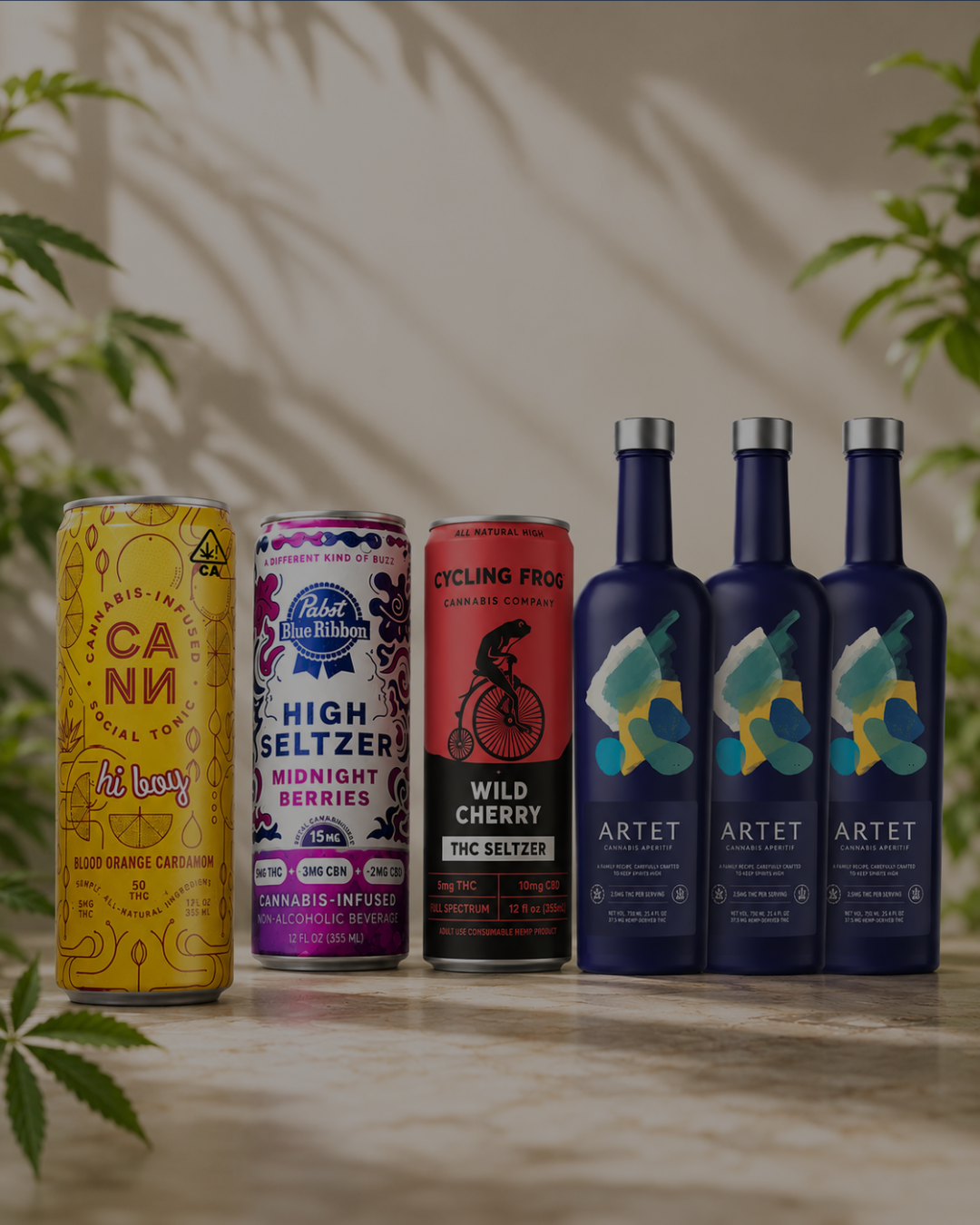
Cannabis Beverages: Everything You Need to Know
What Are Cannabis Beverages?
Globally, the cannabis beverages market was valued at around $809 million in 2025 and is projected to reach $1.7 billion by 2032, with North America representing the lion’s share of that business. In U.S. dispensaries alone, cannabis beverage sales reached $54.6 million in just the first quarter of 2025, up 15% from the same period the year before.
So why are people drawn to them? No smoke, no vape pen, no lingering smell. These drinks fit naturally into social settings like a backyard cookout, a concert, or a night in, and they’re easy to dose. In fact, many people who would never pick up a joint feel completely comfortable cracking open a flavored can.
THC Drinks vs. CBD Drinks: What’s the Difference?
To put it simply, THC gets you high; CBD does not.
THC Drinks
THC is the psychoactive compound in cannabis and the ingredient responsible for the “buzz” or “high” you may have heard about. When a brand infuses THC into a drink, the result is mind-altering effects, including relaxation, euphoria, altered perception of time, and sometimes the giggles. People consume THC drinks recreationally and, in some cases, medically for pain relief, sleep, or anxiety.
CBD Drinks
CBD, on the other hand, is a non-psychoactive compound, meaning it will not get you high. Instead, brands market CBD drinks toward wellness and relaxation. People use them to help manage stress, reduce muscle soreness, or simply wind down after a long day, all without any intoxication. As a result, you’ll find CBD sparkling waters, teas, and even coffee on shelves across the country.
Full-Spectrum & Blended Drinks
Beyond the two main types, some beverages combine both THC and CBD along with other minor cannabinoids, for what the industry calls a “full-spectrum” or “broad-spectrum” experience. The thinking is that the different compounds work better together than they do alone, a concept known as the entourage effect.
| Feature | THC Drink | CBD Drink |
|---|---|---|
| Will it get you high? | Yes | No |
| Primary use | Recreation & some medical | Wellness & relaxation |
| Where it’s sold | Dispensaries & some retailers (see Section 5) | Health stores, grocery, online |
| Legal status | Varies by state; hemp-derived versions are federally legal | Federally legal (hemp-derived) |
| Common forms | Seltzers, tonics, mock cocktails | Sparkling water, tea, coffee |
| Typical dose | 2.5 mg – 100 mg THC | 10 mg – 50 mg CBD |
Beginner Tip
If you’re brand-new to cannabis beverages, many experts suggest starting with a low-dose THC drink (2.5–5 mg) and waiting a full hour before considering a second sip. Because beverages are absorbed differently from smoking, the effects can be subtle at first and then build gradually.
How Long Do They Take to Kick In?
This is where cannabis beverages have a real edge over traditional edibles like gummies or brownies. With a standard edible, you might wait 45 to 90 minutes or longer to feel anything, which leads to the classic mistake of eating more because “it’s not working.” Beverages are generally faster, thanks to a technology called nanoemulsification.
What Is Nanoemulsification?
Here’s the science in plain English: THC is naturally oil-based, and oil doesn’t mix with water. Early cannabis drinks struggled with this problem; they’d taste off, separate in the can, or absorb unpredictably. Nanoemulsification solves this by breaking THC molecules down into incredibly tiny particles, about 1,000 times smaller than the width of a human hair, and coating them so they blend seamlessly into liquid. Once you drink it, your mouth, esophagus, and stomach lining quickly absorb these microscopic particles, bypassing much of the slow digestion process that makes traditional edibles take so long.
Some premium nano-THC beverages report initial effects as quickly as 7–15 minutes. Carbonated versions may absorb slightly faster due to increased stomach permeability.
Most quality THC beverages begin producing noticeable effects within 15–45 minutes, which is still 2–4× faster than a traditional edible.
Effects usually reach their peak around 60–90 minutes after drinking, similar to edibles but with a smoother, more predictable climb.
Nano-emulsified beverages typically wear off within 2–4 hours, which is shorter than traditional edibles that can last 4–6 hours. That shorter window makes the overall experience more controllable.
Keep in mind that onset time can vary based on your metabolism, body composition, how much you’ve eaten, and your tolerance. An empty stomach will speed things up; a heavy meal can delay effects by an additional 20–40 minutes.
How Cannabis Beverages Affect the Body
When you drink a THC beverage, the cannabinoids travel through your digestive system and eventually enter your bloodstream. From there, THC crosses the blood-brain barrier and binds to receptors in your brain and nervous system, specifically within what scientists call the endocannabinoid system (ECS).
The ECS is a network of receptors found throughout your body that helps regulate things like mood, sleep, appetite, pain, and memory. THC mimics the body’s own natural compounds (called endocannabinoids), binding to these receptors and altering normal function. Altogether, this process produces the characteristic effects people associate with cannabis.
Common Effects of THC Beverages
At low doses (2.5–5 mg), a THC beverage typically produces mild relaxation, a slight uplift in mood, and heightened sensory awareness, similar to having a glass of wine. At moderate doses (10–25 mg), effects become more pronounced and may include euphoria, altered time perception, increased appetite, and deeper relaxation. Higher doses, however, can produce anxiety or discomfort, particularly in people who are new to cannabis.
One Important Difference from Traditional Edibles
When the liver slowly digests THC from a traditional edible, it converts into a compound called 11-Hydroxy THC, which tends to produce a stronger, heavier, more sedating effect. Because cannabis beverages using nanoemulsification bypass much of this liver metabolism, they typically deliver a cleaner, lighter, more alcohol-like experience that many people find more predictable and easier to manage.
CBD’s Effect on the Body
Unlike THC, CBD does not bind to the same brain receptors, which is why it doesn’t produce psychoactive effects. Instead, CBD interacts with receptors related to inflammation, pain signaling, and serotonin regulation. Most people who consume CBD beverages report a gentle sense of calm or physical ease without any cognitive impairment, something often described as “taking the edge off” without feeling buzzed.
Why You’re Seeing Them at Target & Total Wine
Not long ago, the idea of walking into a big-box retailer and buying a THC drink felt far-fetched. Today, it’s a reality, and the reason comes down to a single piece of legislation: the 2018 Farm Bill.
Congress passed the 2018 Farm Bill to legalize the commercial cultivation of hemp in the United States, defining it as cannabis containing no more than 0.3% delta-9 THC by dry weight. That seemingly small legal distinction created a massive commercial opportunity. Because a can of liquid weighs far more than the cannabinoids it contains, a 12-ounce beverage can legally hold up to 10 mg of THC (a meaningful psychoactive dose) and still stay within the 0.3% dry-weight limit. In short, the law opened the door for brands to sell intoxicating hemp-derived THC drinks at regular retail stores.
Target
In October 2025, Target became the first major national big-box retailer to enter the cannabis beverage market, launching a pilot program in 10 Minnesota stores. By May 2026, the company had expanded to over 300 stores across Texas, Florida, and Illinois, stocking both 5 mg and 10 mg THC hemp drinks alongside local and national brands. Industry observers called it a watershed moment, pointing to it as a sign that mainstream America is ready for cannabis beverages on the same shelf as sparkling water and energy drinks.
Total Wine & More
Total Wine, the national wine and spirits chain, moved into the hemp THC beverage category earlier and more aggressively. The chain began prominently displaying THC drinks across many of its locations, and in some stores it replaced 10–20 feet of craft beer shelf space with cannabis beverages. Brands like Mountain High, Buzzin’ Breeze, and Citrus Bliss now sit alongside wine and spirits, priced at just $5–$7 per can.
Additionally, other retailers have entered the space: convenience chain Circle-K began offering hemp THC beverages in select states, and major alcohol distributors like Breakthru Beverage announced they would carry THC drinks in legally permissible markets.
A Note on Regulatory Uncertainty
The hemp THC beverage space is still evolving legally. In November 2025, Congress passed a government funding bill that included provisions tightening the definition of hemp, potentially restricting THC content in hemp products after November 2026. As a result, Target has reportedly been preparing contingency plans. The situation remains fluid, and regulations may continue to shift at both the state and federal levels. Some states, including California and Ohio, have already moved to restrict hemp-derived THC sales to licensed dispensaries.
Hemp THC Drinks vs. Dispensary Cannabis Drinks: Are They the Same?
This is one of the most important distinctions to understand, especially if you’re in or entering the cannabis industry.
Legally and botanically, hemp and marijuana are the same plant. The difference is purely regulatory: cannabis qualifies as hemp if its delta-9 THC content sits at or below 0.3% by dry weight, and as marijuana if it exceeds that threshold. Above 0.3%, the federal government still classifies the plant as a Schedule I controlled substance, meaning sellers can only offer it in licensed dispensaries in states where cannabis is legal.
| Feature | Hemp-Derived THC Drinks (Retail) | Cannabis-Infused Drinks (Dispensary) |
|---|---|---|
| Source | Hemp plant (≤0.3% THC by dry weight) | Cannabis/marijuana plant |
| Federal legal status | Federally legal under 2018 Farm Bill | Federally illegal (Schedule I) |
| Where it’s sold | Liquor stores, retail chains, online | Licensed cannabis dispensaries only |
| Potency range | Typically 2.5–20 mg THC per can | Can range from 2.5 mg to 100+ mg |
| Testing & oversight | Varies; often third-party lab tested | Strict state-regulated lab testing |
| Available in non-legal states? | Often yes (where hemp law applies) | No |
| Do the effects differ? | At equivalent doses, effects are largely similar | At equivalent doses, effects are largely similar |
So do they feel different? At equivalent doses, hemp-derived THC and cannabis-derived THC produce the same effects in the body because the two are chemically identical. The main practical differences lie in where you buy them, how regulators oversee them, and the potency ceiling. Dispensary beverages can legally go much higher in THC content, and state agencies subject them to more rigorous testing and labeling standards. Hemp retail drinks, by contrast, carry lower absolute doses (to stay within the 0.3% dry weight threshold), and while oversight is less standardized, reputable brands publish third-party lab results accessible via QR codes on their packaging.
Want to Turn Cannabis Knowledge Into a Career?
The cannabis industry is one of the fastest-growing sectors in the U.S., supporting over 440,000 full-time jobs. Cannabis Career Academy offers specialized training in cannabis operations, compliance, retail, and more.
Cannabis Beverage Trends to Watch in 2026
The cannabis beverage category is young, but it’s evolving fast. Here are the biggest trends shaping the space right now.
Cannabis as an Alcohol AlternativeAs younger generations cut back on drinking, low-dose THC beverages (2.5–5 mg) are filling the social drinking void. In California, cannabis-infused drinks surged 40% in sales in 2024 while beer volumes dropped 5% in parallel.
Functional & Wellness BeveragesBrands now position CBD and minor cannabinoid drinks alongside adaptogens, mushrooms, and nootropics. Expect to see more drinks targeting sleep, focus, recovery, and stress that blend CBD with ingredients like ashwagandha or lion’s mane.
Nano-Technology Goes MainstreamAs nanoemulsification becomes the industry standard, brands are rolling out faster-acting, more consistent beverages across every price point, not just premium products. Faster onset makes dosing easier and gives consumers a more predictable experience.
Mainstream Retail ExpansionWith Target and Total Wine leading the charge, more national chains are evaluating hemp THC beverages. Meanwhile, distribution deals with major alcohol distributors are accelerating shelf placement across the country.
Low-Dose “Sessionable” ProductsSimilar to how craft beer popularized session IPAs (lower alcohol, more drinkable), low-dose 2.5 mg THC cans are now outselling stronger 10 mg formats in many retail markets, making cannabis far more approachable for newcomers.
Emerging State Markets BoomingNewer legal states are seeing explosive growth. Michigan cannabis beverage sales more than doubled (up 112%) in Q1 2025 compared to Q1 2024. Ohio was up 79% and Illinois 47% over the same period.